
Great Number Attended Original Federal Event
Ceremonies Under Masonic Auspices Echoed by Oldest Inhabitants of Present Day
By John Clagett Proctor.
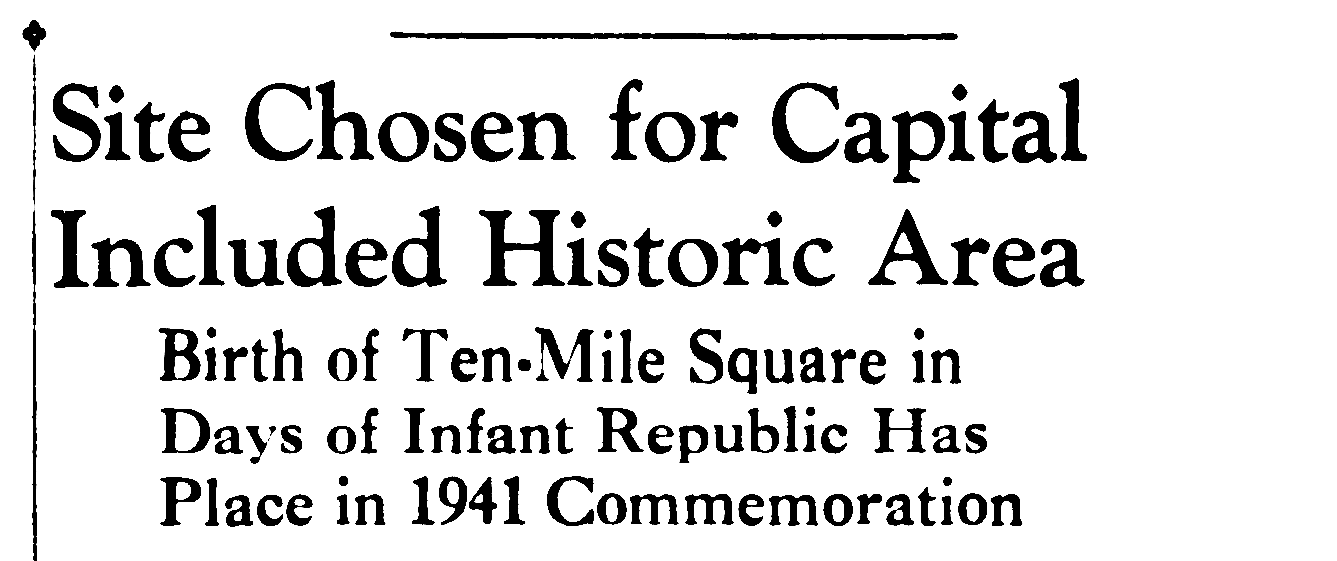
There may be many days in the coming year worthy of commemorating and celebrating, but there is one day in particular that we should not fail to observe, and this is the day upon which the corner stone of the District of Columbia was placed at Jones Point, at the mouth of Hunting Creek, Va., near Alexandria, which took place on April 15, 1791, and therefore April 15 next will be particularly significant, because it will mark the 150th anniversary of the birth of the 10-mile square wherein was placed the Federal Capital.
The so-called Residence Act, passed by Congress and approved by President Washington on July 16. 1790, while Congress was meeting in New York City, confined the territory to be selected for the Capital “on the River Potomac at some place between the mouths of Eastern Branch and the Connogocheague,” and it was not until after the passage of the amendatory act of March 3, 1791, that President Washington was in a position to include Alexandria and what is now Arlington County, Va., in the District of Columbia, but which, however, was retroceded to Virginia in 1846 by a vote of the residents of 763 to 222.
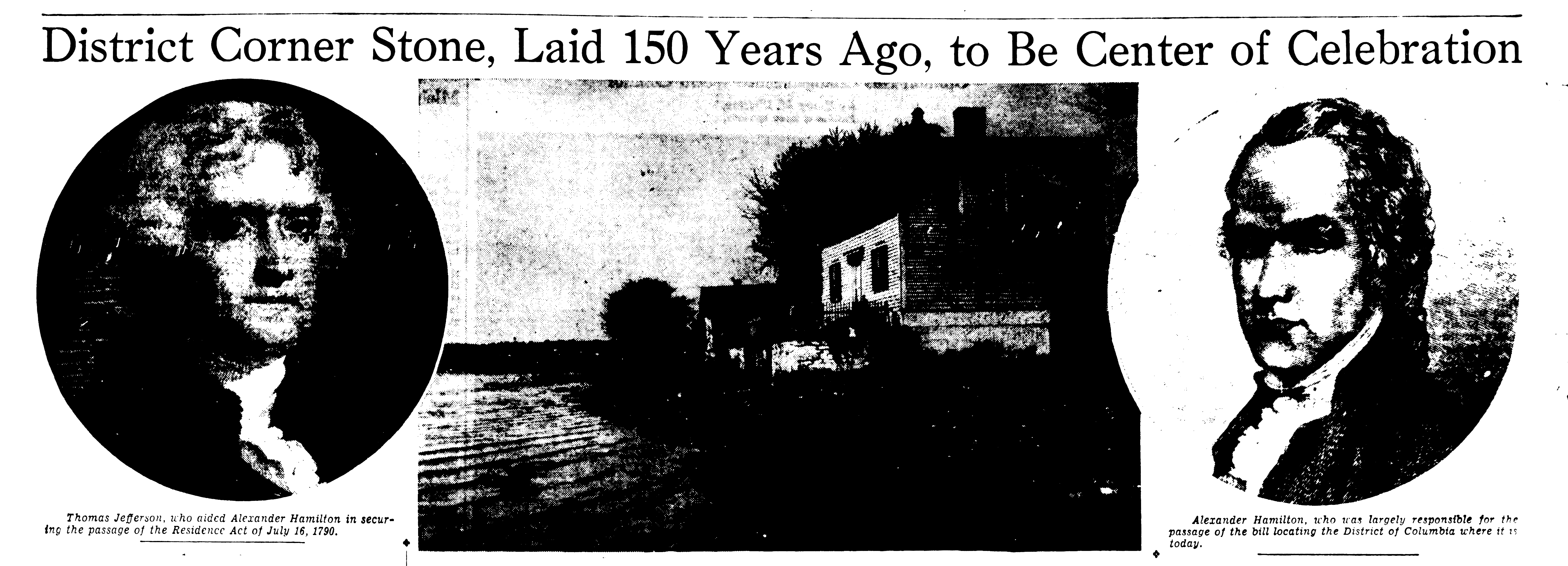
The act of July 16, before mentioned, passed the Senate by the narrow margin of 14 to 12 votes, and in the House by only three votes or 32 to 29. Indeed, the locating of the Capital and the funding bill were two of the knottiest problems before Congress, and the residence bill, as finally passed, required the greatest amount of strategy on the part of such men as Alexander Hamilton and Thomas Jefferson.
Difference in Views.
Just how wide the difference of views was on locating the Capital may be seen by the vote on the four amendments offered to the bill: First, to substitute the Delaware instead of the Potomac, ayes 22, noes 39; second, to locate it in Pennsylvania, including Germantown, eyes 22, noes 39; third, to place it between the Susquehanna and Potomac, ayes 25. noes 36; and, fourth, to locate it in the State of Maryland, including Baltimore, ayes 26. noes 34.
Hamilton was one of the brainiest men of the new Republic, and he was also a brave and gallant soldier and a man of rare financial ability. In this latter connection, like so many Congressmen today, he had a pet measure, and this embraced the idea that the United States as a whole should pay off the foreign debt, amounting to something like $12,000,000, and assume the state debt, totaling $21,500,000.
The Northern States were keen for this legislation. Pennsylvania alone possessed $4,000,000 on which it would draw interest, and in addition to this the citizens held $15,000. 000 upon which they would secure payment. However, Hamilton's motives were not prompted by this fact at all, since he eloquently maintained that the public debt was “the price of liberty.”
Wanted to Satisfy All.
The South was not in favor of the funding bill as proposed by Hamilton. which had been defeated in the House. Hamilton knew that the South wanted the Capital City located within its midst; the North did not. Hamilton's bill meant more toward the salvation of the United States than did the locating of the Federal Capital, a fact the Secretary of the Treasury was also well aware of, and he proceeded in a states manlike way to satisfy both parties, and, above all, to put the newly formed country in a good light before the world. He was willing to locate the Capital anywhere to secure the passage of his bill and he so informed Morris and Jefferson.
Of this Jefferson says:
“As I was going to the President's one day I met him (Hamilton) in the street. He walked me backwards and forwards before the President's door for half an hour. He painted pathetically the temper into which the Legislature had been wrought; the disgust of those who were called the creditor States; the danger of the secession of their members and the separation of the States. He observed that the members of the administration ought to act in concert; that though this question was not of any department, yet a common duty should make it a common concern; that the President was the center on which all administrative questions ultimately rested, and that all of us should rally around him and support with joint efforts measures approved by him.
“I proposed to him, however, to dine with me the next day and I would write another friend or two, bring them into conference together, and I thought it impossible that reasonable men, consulting together coolly, could fail, by some sacrifices of opinion, to form a compromise which was to save the Union.
“But it was finally agreed that, whatever importance had been attached to the rejection of the proposition, the preservation of the Union and of accord among the States was more important. But it was observed that this pill would be particularly bitter to the Southern States and that some concomitant measure should be adopted to sweeten it a little to them. There had been before propositions to fix the seat of government either at Philadelphia or Georgetown on the Potomac, and it was thought that by giving it to Philadelphia for 10 years, and to Georgetown permanently afterward, this might, as an anodyne, calm, in some degree, the ferment which might be excited by the other measure alone. So two of the Potomac members, White and Lee—but White with a revulsion of stomach almost convulsive—agreed to change their votes * * * and so the assumption was passed,” as was the Residence Act.
Alexander Hamilton was a great man in many ways, and not only did he handle the Residence Act with skill but proved of great help in framing the Constitution, of which he once said:
“Now, mark my words: So long as we are a young and virtuous people, this instrument will bind us together in mutual interests, mutual welfare and mutual happiness, but when we become old and corrupt it will bind us no longer.”
Provisions of Act.
In the Residence Act of July 16, 1790. the President was “authorized to appoint and by supplying vacancies happening from refusals to act or other causes to keep in appointment as long as may be necessary three commissioners, who, or any two of whom, shall under the direction of the President, survey and by proper meets and bounds define and limit a district or territory, under the limitations above mentioned and the district so defined, limited and located shall be deemed the district accepted by this Act for the permanent seat of Government of the United States.”
In accordance with this provision, the Chief Executive, on July 22,1791, appointed for this purpose Thomas Johnson and Daniel Carroll of Maryland and David Stuart of Virginia.
“Thomas Johnson,” as has been said, “was a resident of Frederick, Md., and an old friend of President Washington. Prior to the Revolutionary War he had been interested with the latter in the project of rendering the upper Potomac and its tributaries navigable by a series of improvements in the channel and the construction of canals around the Great and Little Falls. As one of the Representatives of the State of Maryland in the Continental Congress, he had nominated Washington to be commander in chief of the Continental Army and he had later served under Gen. Washington in the Army. After the Revolutionary War he had taken an active part with Washington in reviving the project of improving the navigation of the Potomac, and after the organization of the Potowmack Co. for that purpose in 1785had given special attention to the supervision of the work which the company undertook. He had been the Governor of his State and at the time of his appointment as commissioner was its chief justice. Shortly after his appointment as commissioner President Washington appointed him to the Supreme Court of the United States to take the seat vacated by Mr. Rutledge. He continued to serve as commissioner while holding his place on the Supreme Bench. He was of a brusque, impetuous temperament, and was strongly addicted to swearing, though he is spoken of as generous and warm-hearted.
Man of Capacity.
“President Washington probably was moved by a number of considerations to name Mr. Johnson as one of the commissioners. He knew that the latter's residence near the location of the new city and his interest in the Potowmack Co. would give him a strong incentive to push the development of the city. He knew from observation of Mr. Johnson's efforts in directing the work of the Potowmack Co. that he was a man of great energy and executive capacity. He knew him to be an astute lawyer, thoroughly grounded in the Maryland laws, and he doubtless anticipated that such a man would be invaluable as legal adviser to the commission, and particularly in preparing the conveyances which would be required in carrying out his scheme for acquiring the site for the proposed city and in drafting such legislation as would be needed to facilitate the work of the commission. “Daniel Carroll was a resident of Carroll Springs. Montgomery County, Maryland. He was born at Upper Marlboro, and with his brother, John Carroll, had received a finished education abroad. His brother entered the priesthood and later became the first Catholic Bishop of Baltimore and founder of Georgetown Academy—afterwards Georgetown University.
“Daniel Carroll had been a member of the Continental Congress and of the Constitutional Convention and at the time of his appointment as commissioner was a member of the United States House of Representatives from Maryland. On this account he declined to accept the appointment as commissioner until the expiration of his term in Congress on March 4, 1791, when a new commission was sent him. He was commonly spoken of as Daniel Carroll of Rock Creek to distinguish him from Daniel Carroll of Duddington.
“David Stuart was President Washington's family physician, and a resident of Alexandria, Va. He had married the widow of John Parke Curtis, the son of the President's wife. He had long been the trusted adviser of President Washington whose correspondence during the early years of his presidency contains numerous letters to Dr. Stuart explaining the President's attitude on public questions, inquiring as to the state of public opinion and soliciting the Doctor's views and advice. In a sense the doctor may be regarded as having been the President's personal representative in the commission.”
Rapid Action Needed.
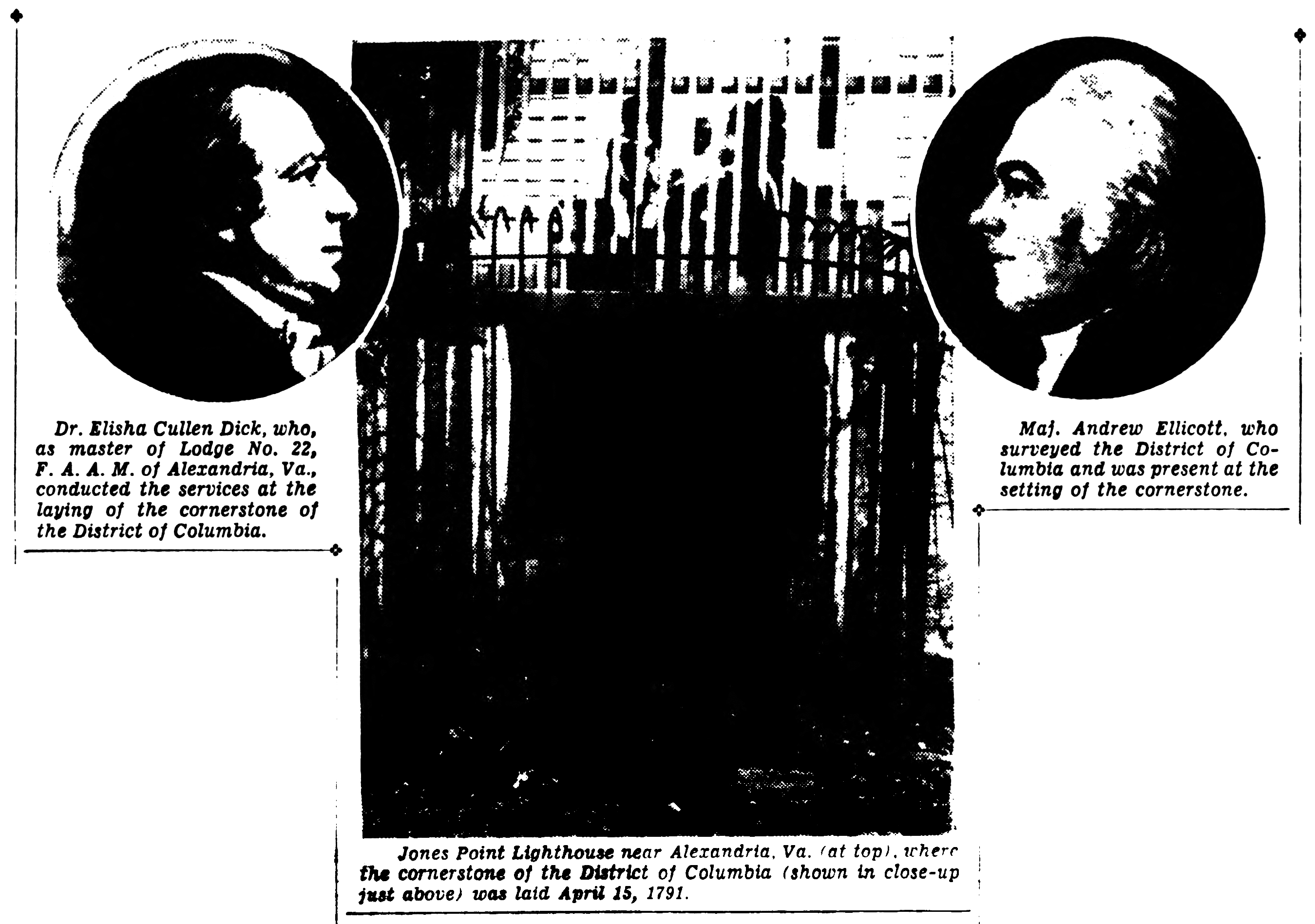
Realizing the slim margin by which the residence act had passed the two houses of Congress, the President decided to act rapidly after the amendatory act was signed, and so, on Monday, March 28, Washington arrived in Georgetown and dined at a public dinner at Suter's Tavern, where he also lodged, and while here met the landowners, examined the surveyings made by Maj. Andrew Ellicott and the works of Maj. L'Enfant, and left his lodgings for Alexandria and Mount Vernon two days later.
As evidence of the desire of the commissioners to place the corner stone as soon as possible, we find that upon this occasion a temporary stone was used, and that it was not until June, three years later, that the permanent one, or the stone we see today, was put in position. When we stop to consider that this event occurred a century and a half ago, and also take into account the interest in the exercises at that time, we cannot but realize that those taking part in the laying of this stone must have realized that they were performing an act of historic significance.
The exercises connected with the placing of the stone were conducted under the auspices of Lodge, No. 22. F. A. A. M., of Alexandria, chartered under the grand jurisdiction of Virginia, April 28, 1788, and of which Gen. Washington became the first worshipful master, and the President of the United States on April 30, 1789—just two days more than a calendar year from the first date. This lodge is now known as Alexandria-Washington Lodge, No. 22. and thousands of tourists annually visit its lodge room to see the Masonic relics connected with the life of the first President.
Ignored Superstition.
Some folks do not look upon the number 13 and the week day Friday with favor and avoid both when possible, feeling that they are associated with ill luck or failure, or both. However, our forefathers were not so superstitious, as indicated by the fact that they were willing to start the Nation off with 13 States and even to lay the corner stone of its national territory on a Friday, the day upon which the 15th day of April happened to fall, that year. It was the second occasion upon which Lodge No. 22 was called to perform a similar ceremony, the first being the laying of the corner stone of Alexandria Academy.
There is an abundance of literature extant regarding the laying of the District's corner stone, and just what sort of a day it was can only be assumed. Evidently it was a clear and pleasant April day, such as we are accustomed to have in this vicinity, for otherwise the chronicler would likely have mentioned it. Such is the attitude of our visitors even today. If they should encounter, upon coming here, one bad day in a month they usually return home and speak of the rotten weather they have in Washington, where, as a matter of Weather Bureau statistics, it is one of the finest and most dependable climates in the world.
Dr. Elisha Cullen Dick, who was worshipful master of Lodge No. 22, and who officiated as such at the corner-stone laying, was a close friend of President Washington, attending him in his last illness, making arrangements for his funeral and even finally performing the interesting ceremonies of the Masonic order at his funeral.
Accompanying Dr. Dick to Jones Point, upon this memorable occasion, were, in addition to the officers of the lodge, the mayor and common council of Alexandria and a large number of “citizens and strangers.”
Account of Event.
Arriving at this point. Rev. James Muir. D. D., chaplain of the lodge, delivered an address. A thoughtful writer who happened to be present contributed to a Philadelphia paper the following interesting, though brief, account of the event:
“Alexandria. April 21,1791.
“On Friday, the 15th instant, the Hon. Daniel Carroll and Hon. David Stuart arrived in this town to superintend the fixing of the first corner stone of the Federal District.
“The Mayor and Commonalty, together with the members of the different lodges of the town at three o'clock waited on the commissioners at Mr. Wise's, where they dined, and drank a glass of wine to the following sentiment, viz:
“ ‘May the stone which we are about to place in the ground remain an immovable monument of the wisdom and unanimity of North America.” The company proceeded to Jones Point in the following order:
“First—The town sergeant.
“Second—Hon. Daniel Carroll and the Mayor.
“Third—Mr. Ellicott and the recorder.
“Fourth—Such of the common council and aldermen as were not Freemasons.
“Fifth—Strangers.
“Sixth—The master of Lodge No. 22. with Dr. David Stuart on his right and the Rev. James Muir on his left, followed by the rest of the fraternity, in their usual form of procession.
“Lastly—The citizens, two by two.
Placing of Stone.
“When Mr. Ellicott had ascertained the precise point from which the first line of the District was to proceed, the master of the lodge and Dr. Stuart, assisted by others of their brethren, placed the stone.
After which a deposit of corn, wine and oil was placed upon it and the following observations were made by the Rev. James Muir:
“ ‘Of America it may be said, as of Judea of old, that it is a good land and large—a land of brooks, of waters, of fountains, and depths that spring out of the valleys and hills—a land of wheat, and barley, and vines, and fig trees, and pomegranates—a land of oil, olives, and honey—a land wherein we eat bread without scarceness, and have lack of nothing—a land whose stones are iron, and out of whose hills thou mayst dig brass—a land which the Lord thy God careth for; the eyes of the Lord thy God are always upon it; from the beginning of the year even unto the end of the year.
“ ‘May Americans be grateful and virtuous and they shall insure the indulgence of Providence; may they be unanimous and just, and they shall rise to greatness: may true patriotism actuate every heart: may it be the devout and universal wish; peace be within thy walls. O America, and prosperity within thy palaces. Amiable it is for brethren to dwell together in unity: it is more fragrant than the perfumes on Aaron's garment; it is more refreshing than the dews on Hermon's hill.
“ ‘May this stone long commemorate the goodness of God in those uncommon events which have given America a name among nations. Under this stone may jealously and selfishness be forever buried. From this stone may a superstructure arise, whose glory, whose magnificence, whose stability unequalled hitherto, shall astonish the world and invite even the savage of the wilderness to take shelter under its roof.”
“The company partook of some refreshments and then returned to the place from whence they came, where a number of toasts were drunk; and the following was delivered by the master of the lodge (Dr. Dick), and was recovered with every token of approbation:
“ ‘Brethren and gentlemen: May jealously, that “green-eyed monster,” be buried deep under the work which we have this day completed, never to rise again within the Federal District.’ ”
Among Those Present.
In addition to the lodge officers mentioned, the following persons are included among the names of those present:
John Allison, Joseph Greenway, Benjamin A. Hamp, Michael Madden, Col. Dennis Ramsay, Col. Charles Simms, Thomas West, Jesse Taylor, jr., John Harper, Peter Waggoner, James Taylor, Capt. John Hawkins, Jonathan Swift, Robert McCrea, William Hodgson, John Dunlap, William Herbert, Robert Sanford, William Hunter, sr.; Edward Harper, William Hunter, Jr; Charles Turner and Michael Gretter.
Back in 1855 the Government deemed it advisable to erect at Jones Point at the mouth of Great Hunting Creek, on the west bank of the Potomac, a lighthouse, for the protection of navigation and in doing so found it necessary to inclose the Districts cornerstone in the seawall surrounding the structure placed there 64 years before, and in this way it was obscured from view for many years. About 30 years ago it was located and enough of the wall removed so that it might be visible at all times, and a few years subsequent to this it was protected with an iron grating placed there by local members of the Daughters of the American Revolution.
Childhood Recalled.
To ever so many Washingtonians of mellow age, Jones Point Light house means much. For, In their childhood excursion days, when gliding down the Potomac on the “fast and commodious steamer Mary Washington,” they always had to pass this old landmark. Indeed, if they only went as far as Fort Foote, which was almost opposite Alexandria, they still came in full view of the lighthouse. If, however, the boat went as far down the river as Glymont or perhaps to Lower Cedar Point, how glad we tired tots were when we could see in the distance, upon returning home late at night, the light from Jones Point!
Since it takes time to prepare for a celebration of any kind, an early start should be made by the local organizations generally, and nearby bodies, to commemorate in some way the laying of the District cornerstone. The Association of the Oldest Inhabitants has already appointed a committee for this purpose and Invites others to Join in.